top of page
For the Love Of Nature, Art and Bad Humor
A Comic Gallery of Creative Expression in the Pursuit of Knowledge
Spatterdock
Nuphar advena (Cow Lily or Yellow Pond Lily)
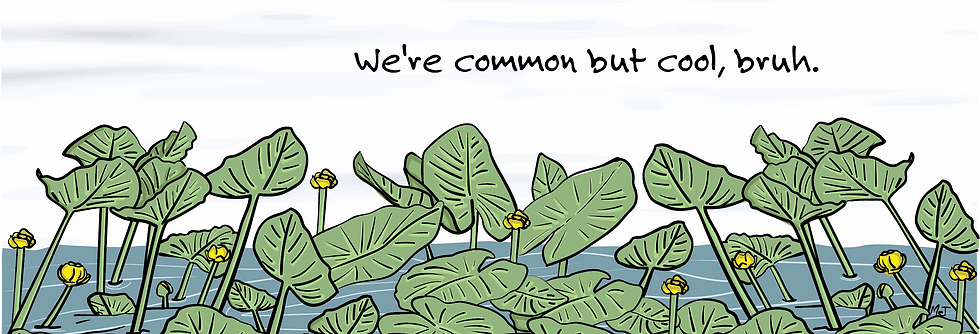
One of the most common aquatic plants in the
Eastern US - and one of the most beautiful. Large, heart-shaped leaves and perpetually half-open, globe-like yellow flowers define these common but unmistakable plants.
Long, thick, spongy stems connect the leaves
and flowers to a floaty-log-looking thing called a rhizome.
The rhizomes have roots and can drift until they find a
muddy bottom to anchor to and call home.

The globe flowers partially open each morning
and close again at night. They bloom all summer
and smell irresistible to pollinators.

Sometimes when the flowers close for the evening, they accidentally trap insects inside - hugging them
like a beloved stuffed animal.

When the sun rises again, the flowers open and release their lil’ captive buddy back into the world.

Eventually the flowers lose their snuggling abilities
and turn into bulging seed heads.
The seed head matures, expands
and ultimately bursts in a poof explosion,
spreading seeds for the next generation at 80 mph.
KA-BOOM!
Baby spatterdocks everywhere.

Despite the exploding, spatterdock is wildly useful.
Deer, rodents, waterfowl, and invertebrates eat it or live in it. Bigger species gather to eat those invertebrates and enjoy the shade and shelter. All that commotion makes it a prime breeding hotspot too. Bow chicka wow wow.

Humans love it too. (Not for breeding, necessarily.)
It's pretty, and technically edible - though bitter
and reportedly tastes like sheep's liver.

Native American tribes dried and ground the rhizome
and seeds into flour for baking. The plant was also used
in traditional medicine to stop bleeding and relieve pain.

The plant's tannins were used for
dyeing and tanning things too.
Spatterdock is the new black?
Crayon creators...take notes.

Spatterdock is native to Florida (and much of the US)
but is considered aggressive.

Just kidding. Not that kind of aggressive.
They grow aggressively. Especially when excess nutrients like nitrogen and phosphorus enter the water. Too many nutrients accelerate growth and these well-fed plants, as well as others, can clog waterways in just a few years.
What nerve.

More importantly, overgrowth reduces oxygen and light in the water, which is bad news for the whole ecosystem.

Removing it by hand backfires too - rhizome fragments and seeds left in the water just make more baby spatterdocks.

The most effective removal is chemical spray.
Effective, but ew, chemicals.
The real solution: stop feeding it.
Fertilizer, leaky septic tanks, and other nutrient-heavy inputs are the problem. Switching to native plants in your landscaping helps - they don't need extra fertilizer or water, so the ecosystem gets what it needs without the overload.
Please don't feed the spatterdock.
Cheers to a healthy population
and all the beauty it brings!

References:
https://plants.ifas.ufl.edu/plant-directory/nuphar-advena/
https://en.wikipedia.org/wiki/Nuphar_advena
http://www.wildsouthflorida.com/spatterdock.html
https://www.fnps.org/plant/nuphar-advena
https://uswildflowers.com/detail.php?SName=Nuphar%20lutea
Special thanks to Jay Exum, Ph.D. Wildlife Ecology for his expert fact checking!
bottom of page