For the Love Of Nature, Art and Bad Humor
A Comic Gallery of Creative Expression in the Pursuit of Knowledge
The Wekiva
A Love Letter

Before the mouse showed up with its churros,
singing robots, and $19 water, tourists came to Central Florida
to see some real magic: the springs!
That crystal-clear spring water has always drawn people,
even before travel blogs told them to.

Springs are incredible.
And so is the story of how they come to be.
(Follow the link for a separate comic about how springs are formed)
But this story centers on a remarkable spring: Wekiwa Springs, Florida’s first and longest-running tourist attraction.
Just north of Orlando, it remains one of the most popular springs in the state, attracting around 434,000 visitors annually.

Wekiwa is a second-magnitude spring discharging roughly
43 million gallons of water daily from the Floridan Aquifer.
That's enough to fill over 2,000 average-sized
residential swimming pools every day!
That water flows downstream for almost a mile until it meets
Rock Springs Run, and that's where the Wekiva River
officially begins. Along the way, it’s joined by two tributaries, Blackwater Creek, and the Little Wekiva River, creating a 42-mile network of waterways fed by more than 34 named springs.
It takes three counties, Orange, Seminole, and Lake,
to hold the Wekiva Basin.
.png)
Eventually, the Wekiva and all its tributaries merge with the St. Johns River and make their journey north to the Atlantic Ocean.

The names Wekiwa and Wekiva come from Creek-Seminole origins: Wekiwa means spring of water, while Wekiva means flow of water.

In 1890, nearly 70 years before Disney started
charging people to stand in line, Wekiwa Springs
(then known as Clay Springs) was already the place to be.
It had a hotel, a bathhouse,and probably a lot of mustaches.
Over the years, the land changed hands multiple times and was
used for hunting and logging before officially becoming a state park
in 1970. The spring’s glittery water, lush tropical hammocks, abundant wildlife, and scenic uplands have drawn hundreds of thousands of visitors annually for generations. Human, plant and animal.

The Wekiva basin is surrounded by more than 100,000 acres of conservation land. This rich and diverse habitat is vital for wildlife, including endangered, threatened, and sensitive species. Among them are the American alligator, wood stork, little blue heron, tricolored heron, limpkin, bald eagle, gopher tortoise, manatee, needle palm,
several orchids and other rare plant species.

And Florida’s biggest black bear population, just casually roaming the place like it’s their backyard. Because it is.
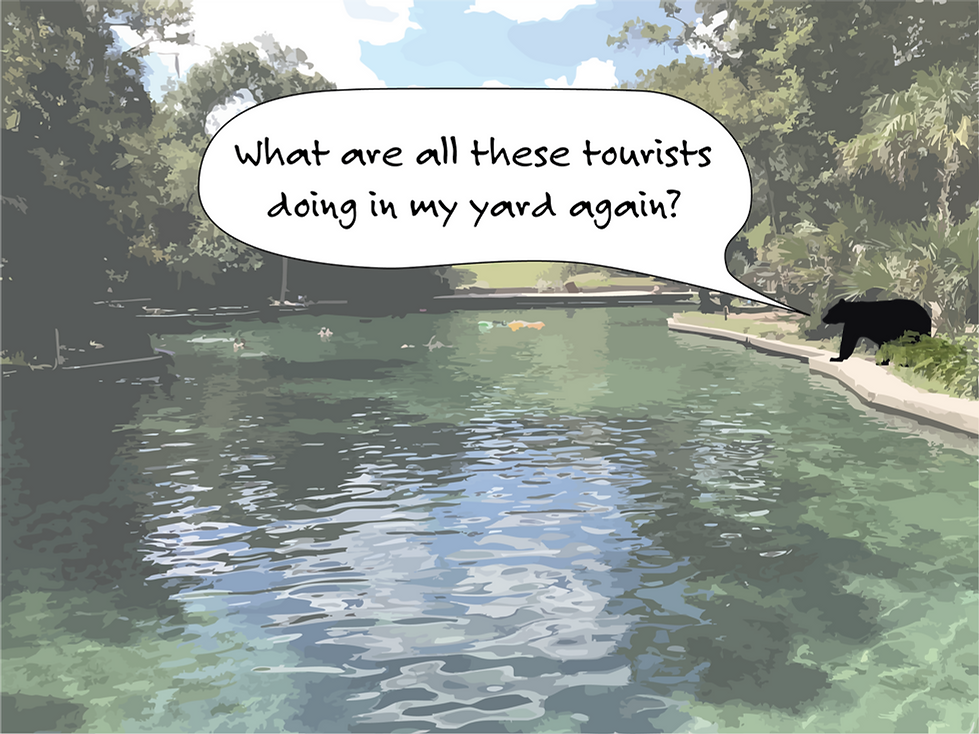
The Wekiva is one of Florida’s most pristine waterways.

The Wekiva is so pristine that it has earned several
impressive designations! (Follow the link for a separate comic
about the Wekiva's stellar report card.) These titles make the Wekiva
as protected as a Grandma's secret cookie recipe.
At least they're supposed to...

Despite all titles and efforts,
the Wekiva River is in trouble.

A pristine picture until you look closer.
There are 3 big problems:
(A separate comic about flow)
(A separate comic about too much)
3. Loss of Habitat & Invasives
(A separate comic about bio-die-verisity)

Yeah. Wekiva's problems are BIG.

But so is the
HOPE!
There are 3 big solutions:
(A separate comic with dry humor)
(A separate comic not about deodorant)
(A separate comic about commitment)
Summary:
This is a true love story.
The Wekiva is remarkable, wild, beautiful, and well-loved.

But as in any relationship, just saying I love you isn’t enough.
It’s about how you show it.
The Wekiva and all of Florida’s springs aren’t just pretty
tourist spots. They are givers of life for plants, animals, and people. Yet despite their many protections, they’re in trouble.
Too much pollution is going in, too much water is being pumped out, and what’s left behind is a sad, lifeless, slimy, green mess.

Official efforts are out there, trying to improve the springs’ health, from tightening pumping limits to cutting nutrient pollution.
But lobbying by powerful interests and other political pressures
have stalled most progress. Laws can help, but only up to a point.
The real power lies with us.
If you live in Central Florida, your drinking water comes straight from the Floridan Aquifer, the very same source that feeds the springs.

Spring water
is our water.
That alone should motivate everyone to care.
Even those who don’t particularly love the springs, hugging
cypress trees, or canoeing with prehistoric reptiles.
Tragedies have happened before. Springs that used to be beautiful tourist destinations are now dried up, or just sad, green mud pits supporting little life. The remaining springs are indeed loved.
But perhaps to death. Every year, more visitors trample native plants, leave trash, and erode fragile banks. And even if you clean up after yourself and claim to love the springs, love alone won’t save them.
What matters are the choices we make every day.
At home, at work, everywhere.

This isn’t just a Florida story. It’s a global one. Pollution and overuse can drain any water source, anywhere. We can't assume bureaucracy, activists, and tree-huggers alone are going to save the day.
It's not enough. We need cultural shifts in how we treat our environment because every action or inaction makes a difference.
Stop using so much water.
Reduce the excess fertilizer.
Go native (a real grassroots effort).
Get involved.
We have the power. We have the love.
We just need to show it.

References:
https://www.cfpublic.org/2025-01-17/development-is-taking-a-toll-on-floridas-precious-springs
https://www.floridastateparks.org/parks-and-trails/wekiwa-springs-state-park
https://www.wekivawildandscenicriversystem.com/
https://www.friendsofwekiva.org/
https://myfwc.com/wildlifehabitats/habitat/invasive-plants/weed-alerts/water-hyacinth/
Jay Exum and Mike Cliburn for their expert fact checking!